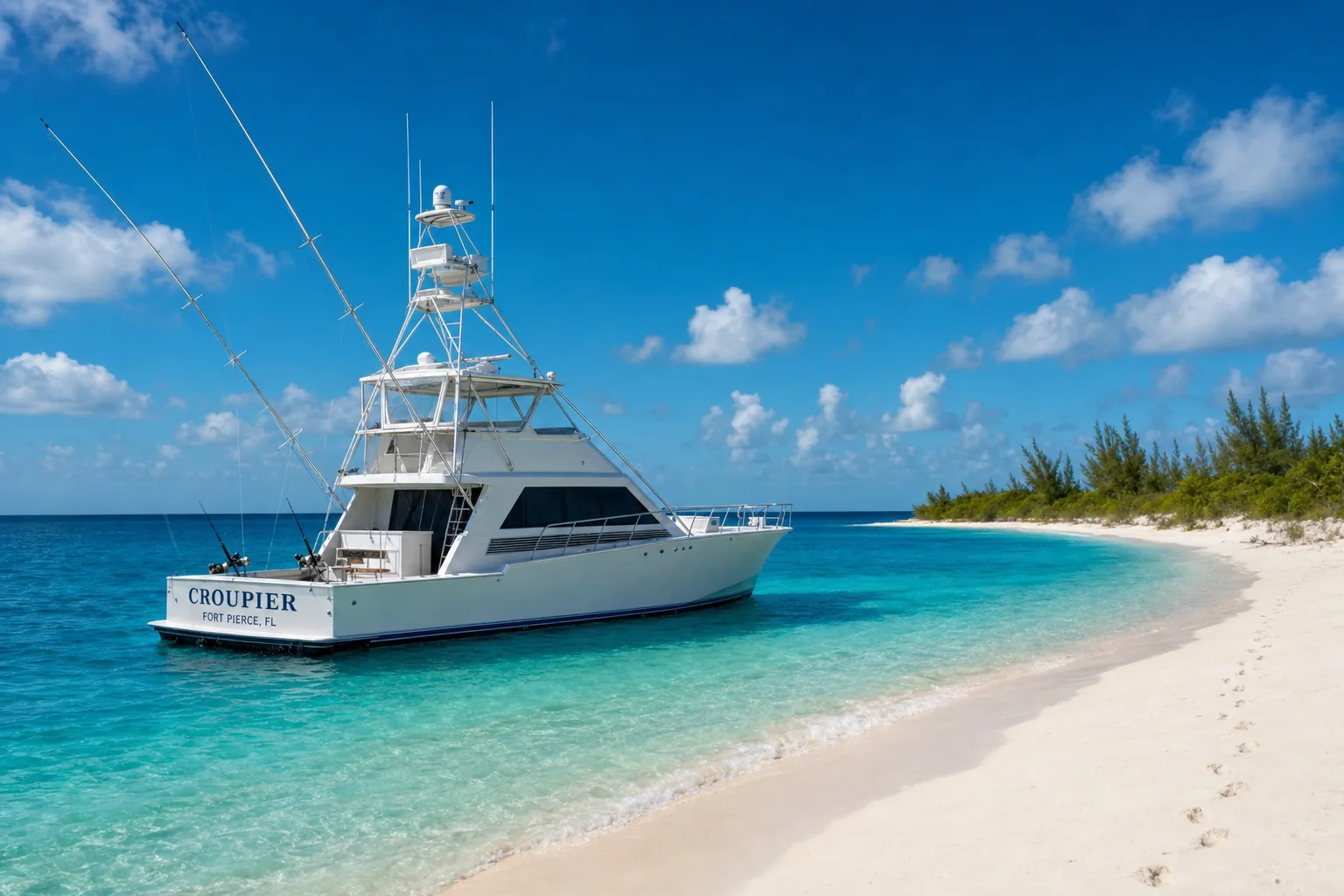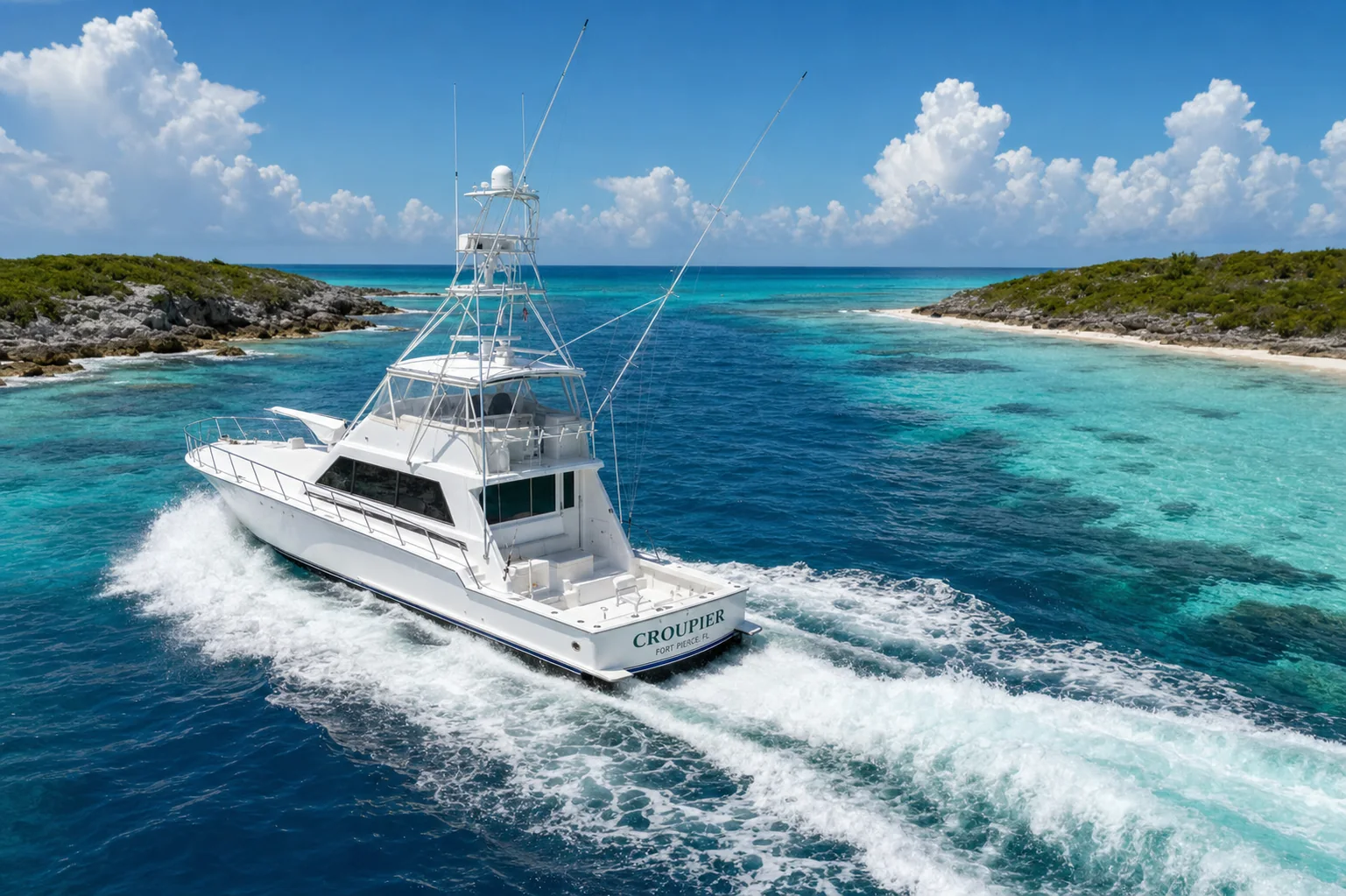
CROUPIER, a 76-foot Knight & Carver sportfisherman, underway offshore

Equity Partnership · Fort Pierce, Florida

A partner position in a refit 76‑footer — a world‑class, custom‑built sportfisher.

Built for tournament fishing — and exotic executive charters.

Rybovich‑renovated · 6½″ hull · They don’t build them like this anymore

Michael Rybovich & Sons renovation. Hull taken back to glass in 2024. Repowered in 2007 with twin Caterpillar C32s, 1,632 hp each. Seakeeper SK26, three staterooms. The capital work is done. What she needs now is a partner who wants to put her to work.

$300,000 Total at closing
76′ Knight & Carver, refit 2024

An equity position in the Florida LLC that owns her, against a $595,000 entry basis — her asking price, not an appraisal of what is in her — with seed money for the partnership’s maintenance reserve built into the number. The full split, the pro forma and the draft term sheet go out to qualified parties on request.

01

The opportunity in one paragraph

The refit is finished. Between 2017 and 2024 this boat absorbed a Michael Rybovich & Sons renovation, new running gear, new electronics, a rebuilt generator pair, a Seakeeper installation, and a complete hull job — sandblasted back to bare glass, refaired and reglassed. That spending is behind her and it is not coming back around. What is left is a boat with no deferred maintenance, a real charter specification, and an owner who would rather run her with a partner than sell her outright.

What’s on offer

A partner’s membership interest in a Florida LLC formed to hold the vessel, at an agreed entry basis of $595,000 — the same number she is publicly offered at. That figure is her asking price, deliberately set at the market band for her model year. It is not an appraisal of what has been put into her.

$300,000Total at closing

Part membership interest, part seed money into the partnership’s maintenance reserve. The reserve portion is not a premium to the seller. Full breakdown travels with the package.

What it’s for

Two things. Cut a substantial fixed annual cost in half, and stand up a charter operation that can carry the rest of it. This is a cost-elimination play with upside, not an income fund.

Who runs her

The incoming partner, or an operator they bring. There is a captain available on call who knows the boat. Day-to-day charter operations, booking, and crew are the partner’s side of the table. The current owner stays on as capital partner and retains limited personal use — he is staying in the boat, not leaving her.

Note

Why the owner is doing this

The plain version: he loves this boat and does not want to lose her. He has also put a great deal of money into her, and the annual carrying cost of a 76-footer is what it is.

Selling solves the cost problem and creates a different one. A partnership solves both — provided the partner is someone who can actually make the charter side work. That is the whole reason this is structured as an operating partnership rather than a passive investment. The owner is not looking for capital. He is looking for an operator who will run her as a high-end charter business, cover the boat’s cost, and make money doing it.

In exchange he takes $300,000 off the table, keeps the majority position, keeps Masters week and his tournament weeks, and keeps the boat.

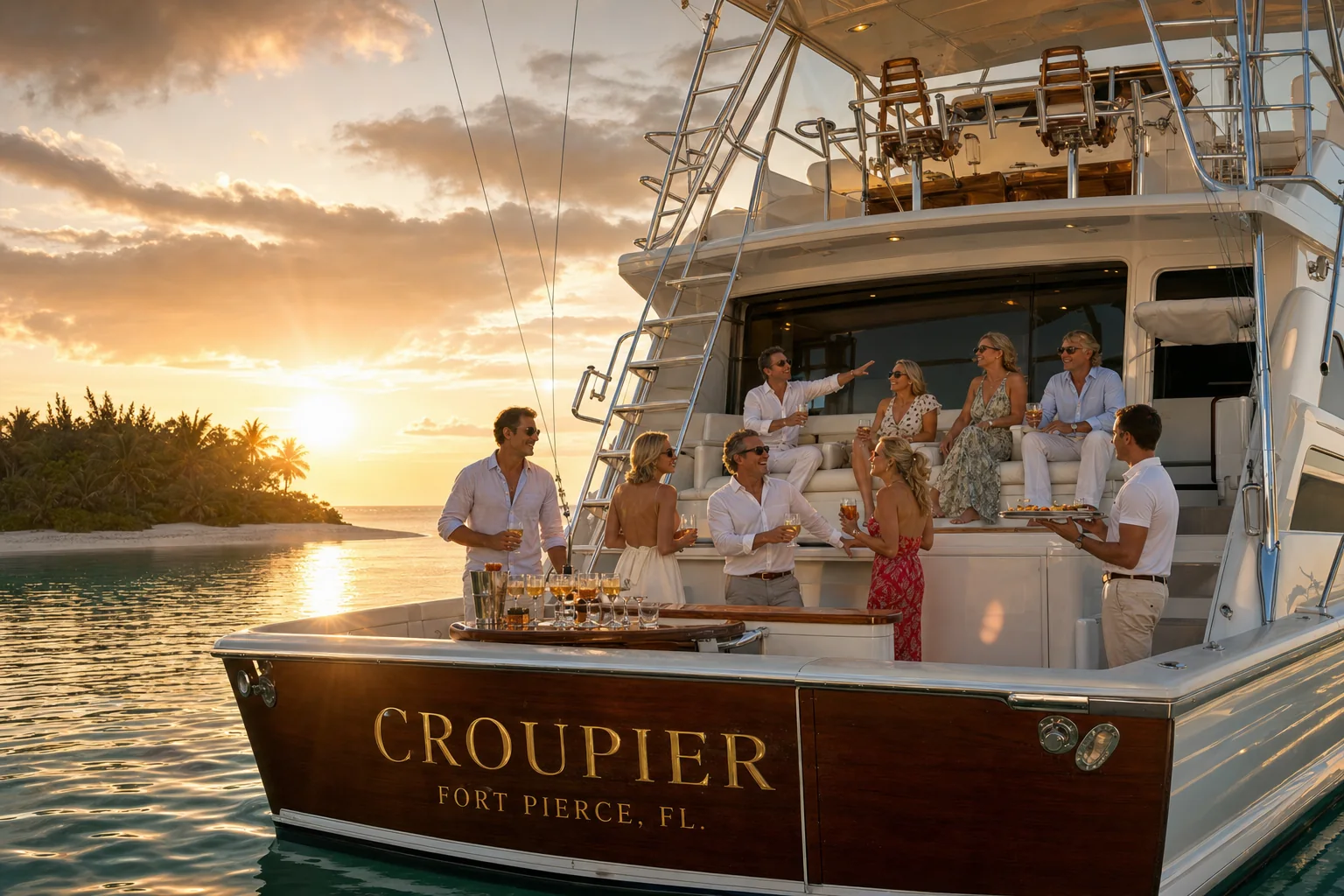
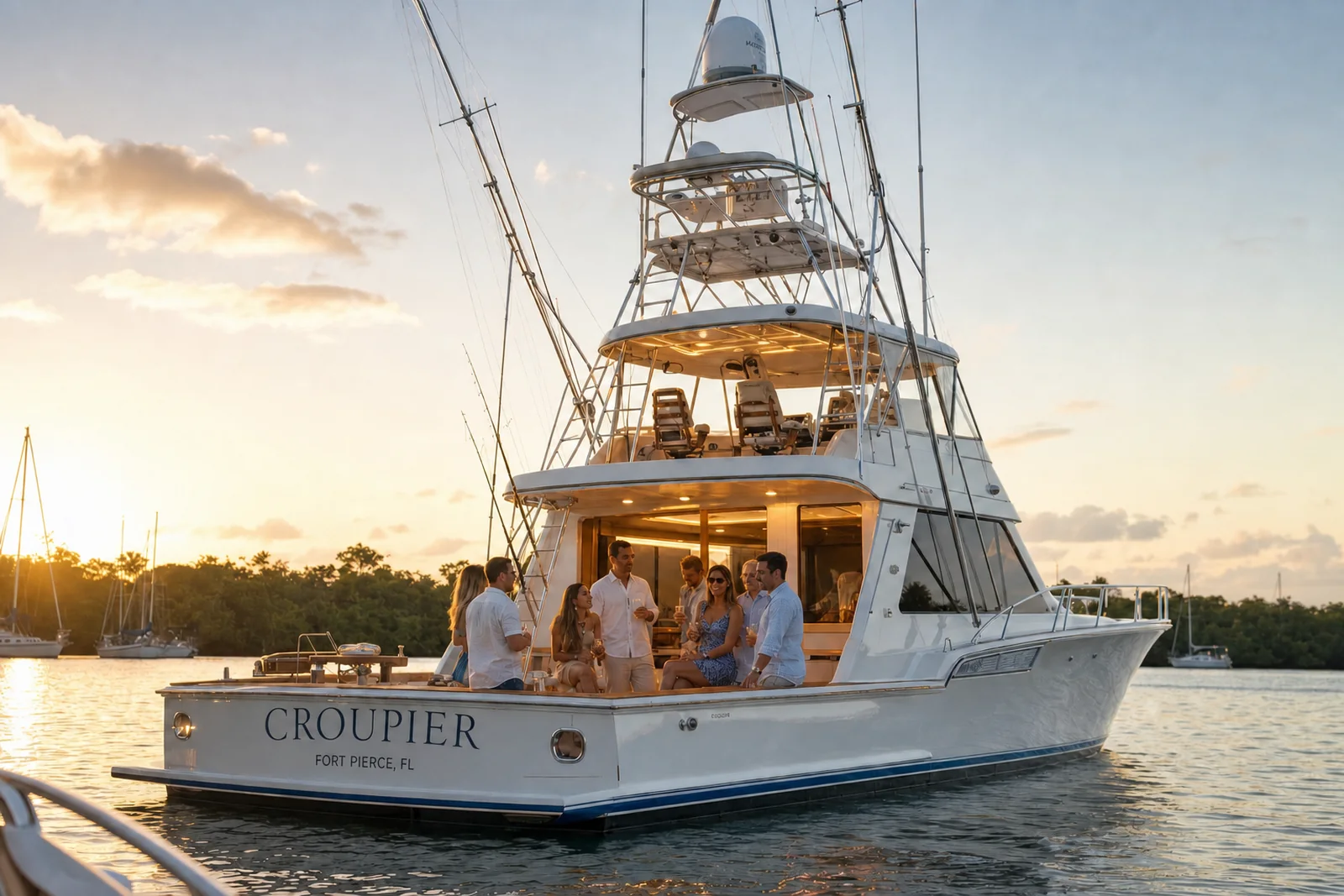
CROUPIER at anchor at golden hour with guests aboard
Plate I — What the charter product actually looks like. Artistic rendering.
02

The vessel

Everything a surveyor is going to ask about has already been answered in writing.

Vessel particulars
BuilderKnight & Carver, custom-built
Year1990
LOA76′ 0″ (23.16 m)
Beam21′ 6″
Max draft7′ 0″
HullFiberglass, 6½″ thick — sandblasted, refaired and reglassed 2024
Engines2 × Caterpillar C32, repowered 2007 — 1,632 hp each, 3,264 hp total
Engine hoursUnder 3,800 — roughly 200 a year since the 2007 repower. 1,000-hour service completed 2023, Smith & Wick, Palm Beach
Propellers5-blade Sound Propeller, 2020
Generators2 × 30 kW Northern Lights, both rebuilt
StabilizationSeakeeper SK26, installed 2017
Speed24.5 kt cruise / 33 kt maximum
Fuel2,550 gal
Water300 gal
Accommodation3 staterooms, 3 heads, day head aft of salon, crew quarters
GalleyAft galley, redesigned in the 2017–18 renovation
BridgeEnclosed and air conditioned — new flybridge enclosure 2024
ElectronicsGarmin 8212 & 8617, Furuno TZ3 25 kW 6′ open array, Airmar 275LWH
LyingFort Pierce, Florida

Refit timeline

  1. 2017–18

    Michael Rybovich & Sons renovation. Aft galley redesigned, interior reworked, Seakeeper SK26 installed.

  2. 2019

    Climate and cooling systems.

  3. 2020

    Running gear. Five-blade Sound Propeller wheels.

  4. 2021–22

    Electronics and steering.

  5. 2023

    CAT 1,000-hour service. New interior soft goods and lighting.

  6. 2024

    Hull taken back to glass. Sandblasted, refaired, reglassed. The largest structural expense on a hull of this vintage, already spent.

    New flybridge enclosure — canvas and clear vinyl over the whole bridge.

  7. 2025

    Cutlass bearings renewed. New VHF radios and antennas throughout.

Note

Nobody is building this boat again.

6½″ Hull thickness

Six and a half inches of solid laid‑up fiberglass. That is not a number a modern yard will quote you, because a modern yard cannot afford to.

It is the whole ride. She does not slam, she does not flex, and she does not talk back to a following sea. Put the Seakeeper on top of that mass and a day that would end most 76‑footers becomes a day your charter guests describe as calm. That matters commercially: a guest who is comfortable rebooks, and a guest who is not never does.

It also matters on the balance sheet. New sportfishers in the 66–80 foot range list between $2.5 million and $6 million, and custom tonnage of this size trades used between $3 million and $8 million. Source: Global Yacht Guide. Across the brokerage market, sportfishers over 50 feet built in the last decade average $5.3 million. Source: United Yacht Sales.

Then Michael Rybovich & Sons went through her in 2017–18, the electronics and running gear were renewed, the hull went back to bare glass in 2024, and the bridge enclosure is two years old. Every system a partner would have to worry about has already been bought.

The only old thing about her is the date on the paperwork. She was built in an era that ended — and what she cost to build is not what she costs to buy into.

Note

What she would cost anywhere else

Look through those photographs again, then go price the finish. Very few sportfishers are appointed to this standard anywhere below the multimillion-dollar market.

New sportfishing yachts in the 66–80 foot range list between $2.5 million and $6 million, and custom tonnage of this size trades used between $3 million and $8 million. Above 80 feet the custom market runs $5 million to $15 million and past it. Source: Global Yacht Guide

Across the whole brokerage market, sportfishing yachts over 50 feet built in the last decade average $5.3 million. Source: United Yacht Sales

CROUPIER is priced at $595,000, and a partner comes in on that same basis.

That number is what a 1990 hull trades for. It is not what this one contains. A surveyor prices the model year; a charter guest prices the boat he walks onto. The entire spread between those two things belongs to whoever owns her.

That gap is not a comment on her. It is the entire opportunity. A charter guest does not price a hull by its model year — he prices it by what he walks into. Book-matched varnished joinery throughout, three staterooms, an enclosed bridge, a teak cockpit and fighting chair, a Michael Rybovich & Sons refit, and a hull taken back to bare glass in 2024.

Now the fair objection, because a serious operator will raise it: those comparables are modern hulls, and CROUPIER was laid up in 1990. That vintage is exactly why she is priced where she is — and it is also why the 2024 hull work matters more than any other line in her history. Taken back to bare glass, sandblasted, refaired and reglassed, she has already absorbed the one expense that scares buyers off a boat this age. What a charter guest steps aboard is a Rybovich-finished interior, an enclosed air-conditioned bridge and a Seakeeper-stabilized ride. He does not ask what year she was built.

She presents like a boat several times that number. More to the point, she charters against boats several times that number — at their rates, on her cost base. That spread is where the margin in this business actually comes from.

Comparable market

Custom 80′+, new $5M – $15M+
Custom 65–80′, used $3M – $8M+
Sportfish 50′+, brokerage average $5.3M
New 66–80′ $2.5M – $6M
CROUPIER, entry basis $595,000

Bars scaled to the top of each published range. Sources linked at left.

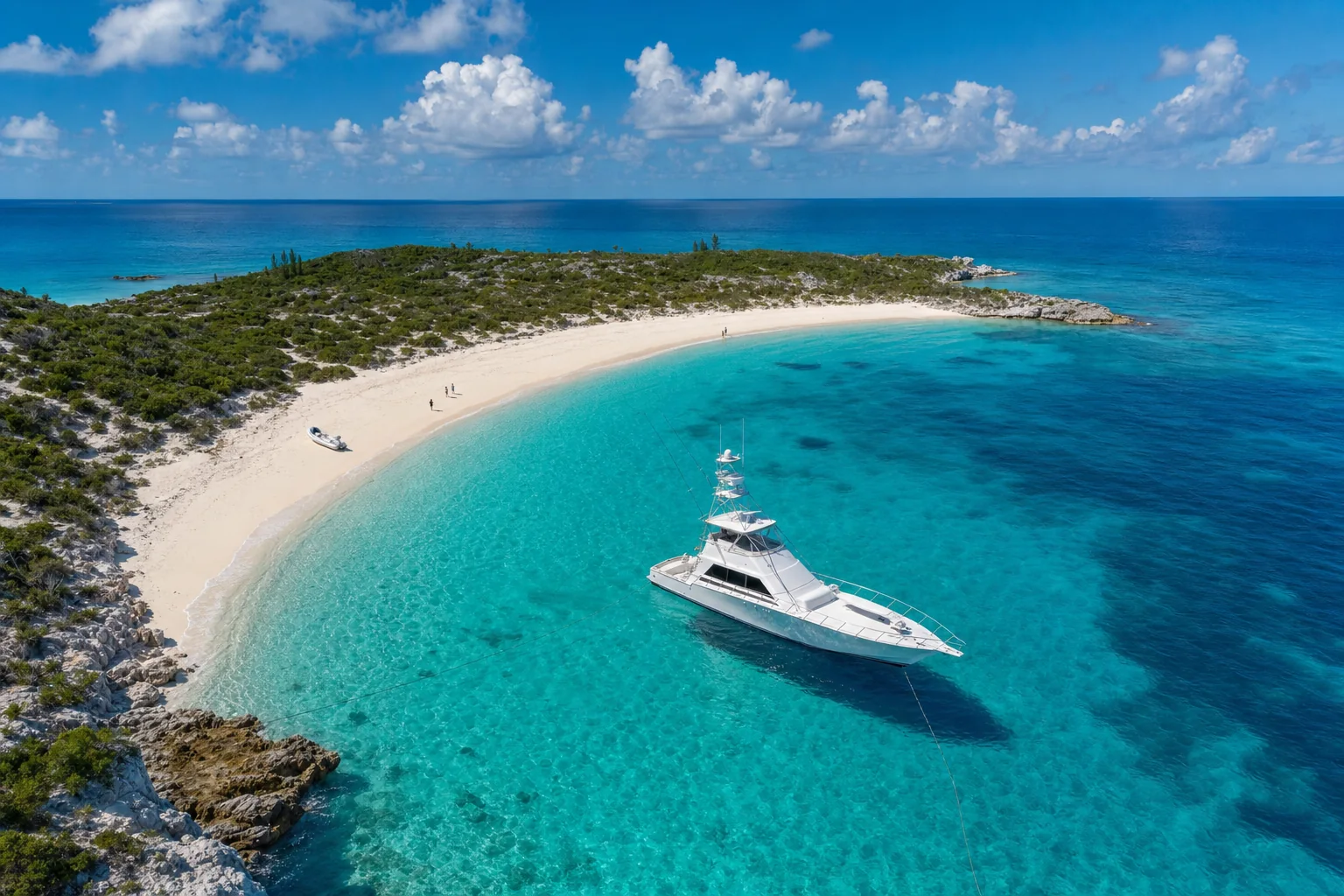
CROUPIER at anchor alone in a horseshoe cove off an uninhabited Bahamian cay
Artistic rendering.
The Vision

Breakfast in Florida. Anchored off a private cay by lunch.

Here is where people misread this boat. They see the tower and the fighting chair and assume the business is fishing.

The fishing is one product. The business is hospitality — and the room we are letting happens to float in the most demanded charter water in the Western Hemisphere.

The client we are building for is not a family on a week’s vacation. It is a fund. A general partner with six limited partners he needs unhurried time with. A firm with four clients each worth more than the vessel. A management team that wants three days where nobody can leave the room, because the room is moving.

Four and five days, Fort Pierce to the Exumas and back. Crewed, catered, and completely private.

56nm Palm Beach to Bahamian water
2h15m That crossing, at her cruise
12 Guests aboard by day · six to eight overnight

Crossing distance 55–56 nm on converging sources. Source: Yachting, Waterway Guide

Note

Why the deck beats the boardroom

Private capital worked this out before we did.

Charter-industry reporting describes mid‑market private equity general partners now routinely taking a yacht for a week and rotating limited partners aboard in three‑night windows, while the largest funds run sixty‑metre boats as an unofficial floating annual meeting. The trade’s own phrase for it is that the summer migration from London, New York and Geneva has been “quietly institutionalised.” Source: Blue Ocean Club

The format is already standardised: partners board first, LP cohorts join for three nights at a time, one structured ninety‑minute session each morning and the rest of the day left deliberately open. That unstructured time is the entire product. Source: Blue Ocean Club

What that costs today: a forty‑metre motor yacht handling twelve guests runs €240,000 to €320,000 all‑in for the week in the Mediterranean. A thirty‑five metre for ten lands between €180,000 and €260,000. Source: Blue Ocean Club

CROUPIER does the same job, for the same guest count, in water that photographs better — two hours from the American coast instead of a transatlantic flight.

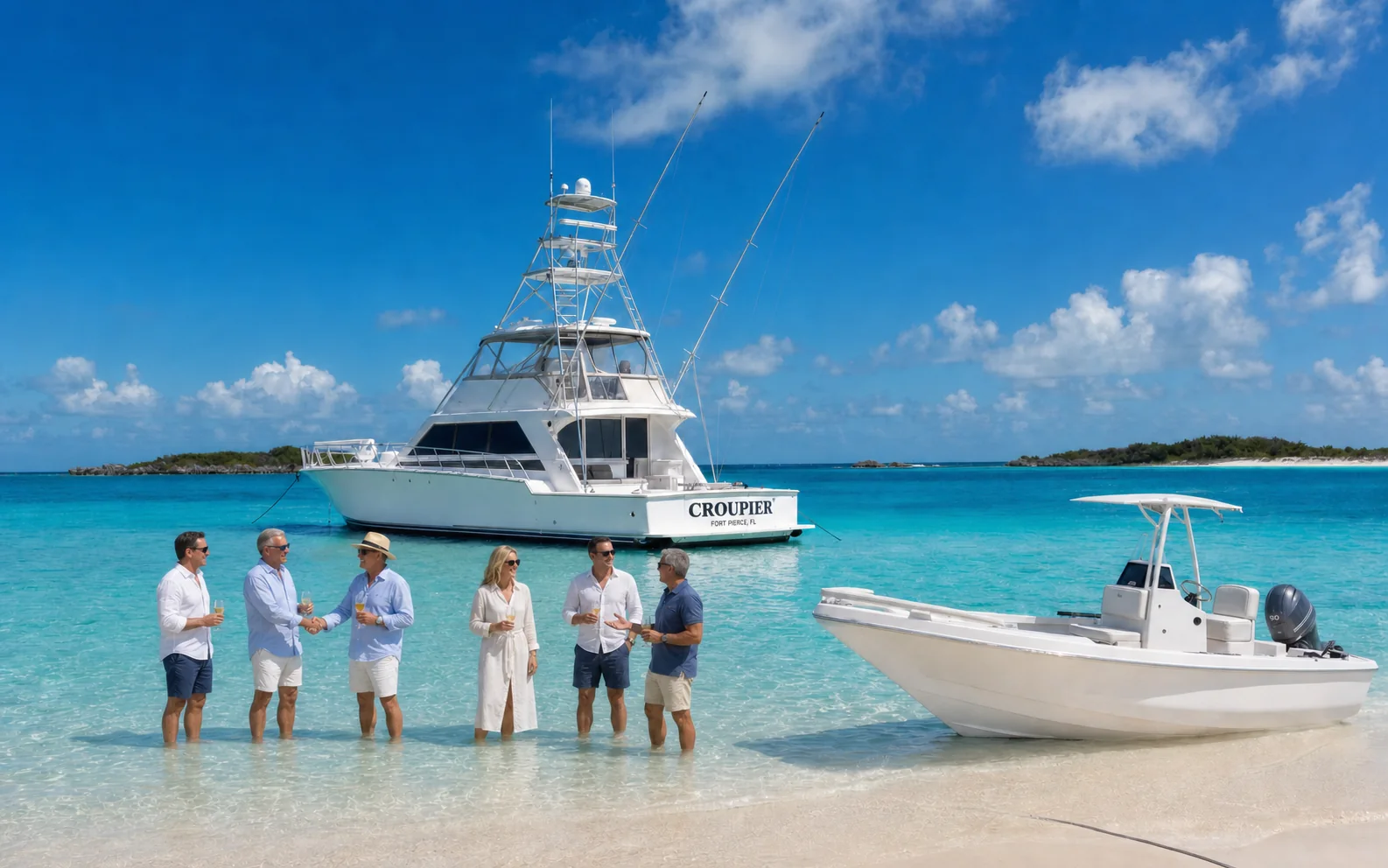
Guests ashore on an Exuma sandbar with CROUPIER at anchor behind
Plate II — A sandbar reception in the Exumas. Artistic rendering.
The Vision

Two runs, and what a guest actually remembers

Neither of these is a fishing trip. The rods stay in the covering board unless somebody asks.

Five days

The Exuma Run

The photograph everybody has already seen, except they are standing in it.

  1. Day one

    Away from Fort Pierce after breakfast, across the Stream, and into Bahamian water before the guests have finished their second coffee. Clear in at West End. First night at anchor, engines off, nothing on the horizon.

  2. Day two

    Down to Nassau to top off and take on anything the galley wants, then out again. Atlantis keeps twelve feet at low water across sixty‑odd megayacht slips and berths to 250 feet — which means she ties up as the small boat on the dock. That is exactly the right feeling to give a guest on night two.

  3. Day three

    Nassau to Highbourne Cay is thirty‑five miles — under two hours. That is the front door to the Exumas: a privately owned island, eight secluded beaches, and a reef called the Octopus Garden. On the way south, the coral‑grown wreck of a Curtiss C‑46 sits in ten feet of water off Norman’s Cay, ditched on a smuggling run in November 1980 and never moved.

  4. Day four

    The heart of it. Thunderball Grotto — a hollow limestone islet with skylights that shaft sunlight into a domed cavern full of snapper and angelfish, and the location for two James Bond pictures. The pigs at Big Major Spot swim a hundred metres out to meet the boat. Nurse sharks at the Compass Cay dock, tame enough to wade among. Dinner at the Staniel Cay Yacht Club, founded 1956 and on Jimmy Buffett’s list of the ten best island bars anywhere.

  5. Day five

    The Exuma Cays Land and Sea Park — established 1958, the first land‑and‑sea park in the world and the first no‑take marine reserve in the Caribbean. Moor at Warderick Wells, walk up Boo Boo Hill, then a long lunch on one of the shifting sandbars at Pipe Creek before turning for home.

Sources: Islands of The Bahamas, Staniel Cay, Atlantis Marina, Boatcrowd
Four days

The Abaco Run

Shorter, closer, and the one that fits a Thursday-to-Sunday.

  1. Day one

    Same crossing, then straight onto the Little Bahama Bank. Marsh Harbour by evening — the hub of the chain, freshly dredged to seven and eleven feet, and one of the few places in the islands that will berth two hundred feet of boat.

  2. Day two

    Hope Town on Elbow Cay, under the candy‑striped Elbow Reef Lighthouse: built 1862, and the last manually operated, kerosene‑burning lighthouse on earth. A keeper still hand‑cranks a weight mechanism every two hours through the night to turn a Fresnel lens floating on a bed of mercury. It burns a gallon of kerosene a night. There are three hand‑wound lights left in the world and this is one of them.

  3. Day three

    Great Guana Cay. Snorkel the barrier reef right off the beach, then up the dune to Nippers for the Sunday pig roast. Past Baker’s Bay — two hundred slips, twelve and a half feet at mean low, boats to 250 feet, and a members‑only gate that a guest will notice.

  4. Day four

    Man‑O‑War Cay, where they have been building boats since the 1880s and still are — and where nearly seven in ten residents descend from one founding family. Then three and a half miles of Treasure Cay beach, consistently ranked among the finest in the region, before the run west.

Sources: IALA Heritage, Elbow Reef Lighthouse Society, Baker’s Bay, Abaco Beach Resort, Man‑O‑War Cay

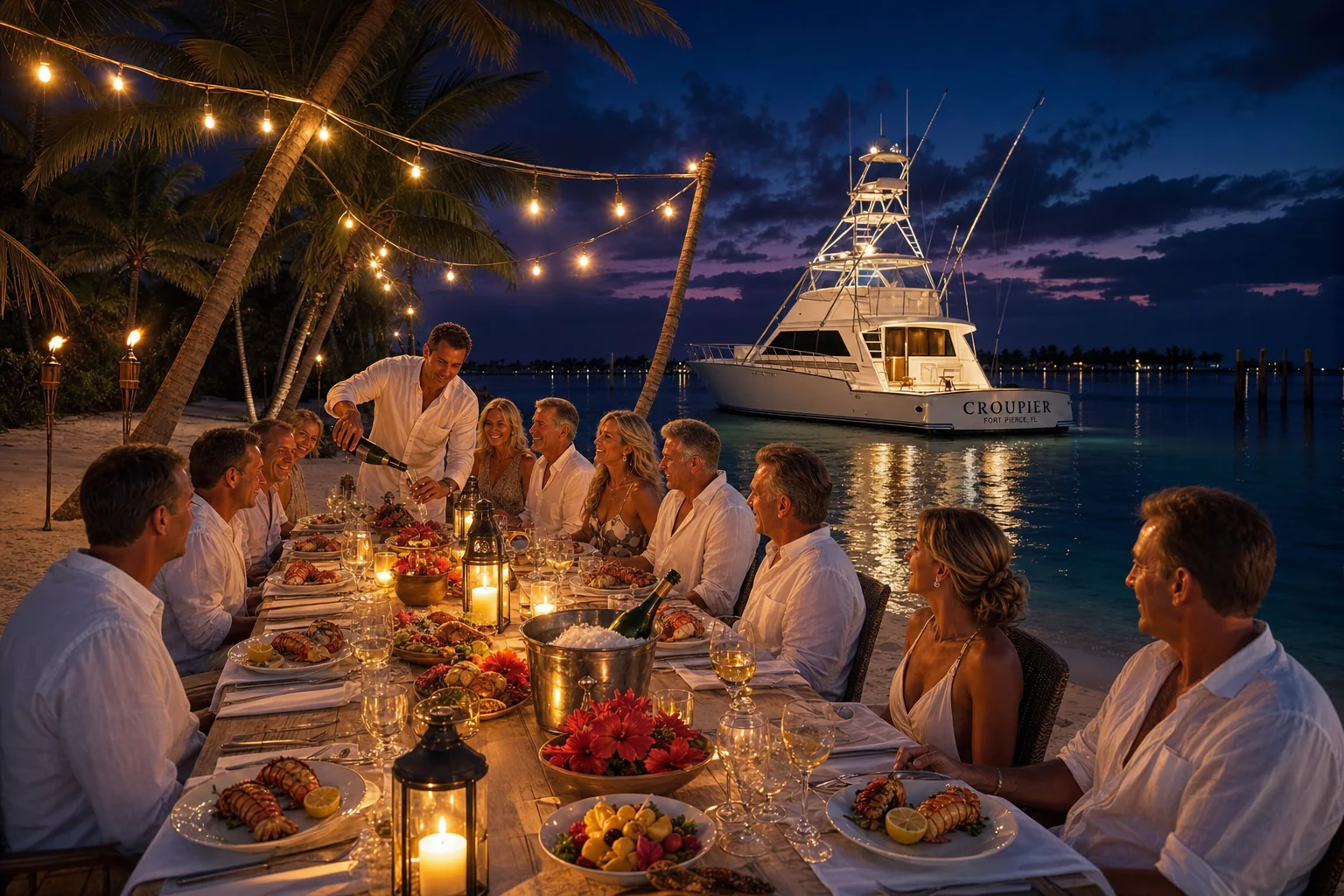
A long table set on the sand at dusk with CROUPIER lit at anchor behind
CROUPIER anchored off a deserted powder-white Bahamian beach
Plates III and IV — Dinner ashore, and the reason the calendar fills. Artistic renderings.
CROUPIER running at cruise through a Bahamian island cut over turquoise banks
Plate V — Running a cut at twenty‑four knots. Artistic rendering.
Note

What an operator will ask before he believes any of this

She draws seven feet. That is real.

The Exumas are cruised on two sides. The Bank side is genuinely shallow — six to eight feet controlling at low water in the popular spots, against a tidal range of three feet or more. Compass Cay’s approach carries about six feet before it deepens to twelve alongside. Shroud Cay’s creeks are tender work and always will be.

Which is why she runs the Exuma Sound side, where the bottom falls to thousands of feet within a couple hundred yards of the rocks, and cuts in through the deep passages to the anchorages that suit her. Staniel Cay’s berths hold ten to twelve feet and want a mid‑tide arrival. Highbourne’s face dock is rated to eight. Nassau, Bimini and Marsh Harbour take her with room to spare — Atlantis alone keeps twelve feet at low water and berths to 250.

This is a seamanship story, not a limitation. A captain who cannot answer it should not have the boat.

The season is the opposite of the fishing calendar.

Prime cruising in both the Exumas and the Abacos runs December through April, with November and May as shoulder months — steady twelve‑to‑fifteen‑knot trades, minimal rain, and effectively no hurricane exposure. Hurricane season is June through November, peaking August to October.

That is the quiet advantage of a hospitality product over a fishing product. The charter calendar fills in the months the tournament calendar does not want, and it empties before the storms arrive.

The boat earns in winter and comes home for the summer. That is the right way round.

Chartering there is legal, and it is a checklist.

A US‑flagged vessel can charter commercially in Bahamian waters with a Foreign Charter Licence — $1,875 a year for a boat between 66 and 101 feet, plus application and inspection fees. Charter tax runs 14% of the charter value. Guests must originate outside the Bahamas.

As of 2025 the rules tightened: charters must be arranged through an approved Bahamian broker rather than self‑booked, and any foreign vessel over fifty feet must keep AIS operating at all times in Bahamian water.

Budget the licence, the tax and a Bahamian broker relationship from day one. None of it is a surprise if you plan for it.

Sources: Government of The Bahamas — Registering a Foreign Charter, Bahamas Boating Regulations, Bahamas Maritime Law Updates 2025–2026, Waterway Guide — Exumas, Staniel Cay Yacht Club, Sail Abacos — Exuma weather

Guests at cocktail hour in CROUPIER's cockpit and mezzanine at golden hour
Plate VI — Cocktail hour, day three. Artistic rendering.
04

The economics

Why the charter math actually works on this boat.

The hard money is already spent. Seven years of continuous refit — Rybovich renovation, running gear, electronics, engine service, and a hull taken back to bare glass in 2024 — are behind her. No deferred maintenance, no capital project waiting on the far side of closing. The expense that breaks most charter programs in year one has already been paid.

Comparable tonnage in the Bahamas books between $18,000 and $35,000 a week, and the guest funds fuel, provisioning and dockage separately on top of that. A moderate season carries the boat’s entire annual cost. A strong one turns her into a business that pays both partners and still leaves the calendar wide open for tournaments.

$18k–$35k Per booked week

What comparable 70–72′ tonnage charters for in the Bahamas today. Charter Specialists

25–35% On top, guest-funded

The Advance Provisioning Allowance covers fuel, food, dockage and fees as a pass-through — it never touches your margin. Global Yacht Guide

$250k+ Gross, moderate season

Twelve booked weeks at mid-range comparable rates. A strong season runs meaningfully higher, and the boat still sits idle most of the year.

$595,000 Entry basis

The partner buys in against this number — not a broker’s asking price and not a survey guess.

The full pro forma

The complete model comes with the package.

Built line by line, the way an operator would want to see it: annual operating cost broken out by category, three charter scenarios costed to the dollar, crew on a day rate rather than salary, management commission, permits, and every assumption footnoted to a public source you can verify yourself. Nothing hand-waved.

The headline: a moderate twelve-week season covers every bill the boat generates and still distributes to both partners. A strong season turns real profit. Even a slow first year — half the calendar a working charter boat books — lands near break-even, and that is a rare thing to be able to say about a 76-footer.

And the operator keeps the upside. Build the book, add weeks, raise the rate, and the boat goes from paying for herself to paying you.

The full package goes out after a phone call.

05

Operating territory

The model on the previous page is built on the Bahamas because it is the most conservative credible assumption and the water is four hundred miles from the dock. It is not the only place this boat can work, and it is not the best-paying one. Where she runs is the managing partner’s decision, not the owner’s.

Modeled — base case

The Bahamas

Bimini, the Abacos, the Exumas · roughly April through November

$18,000–$35,000 per week

Directly comparable 70–72ft tonnage lists in this range, with an Advance Provisioning Allowance of 25–35% carrying fuel, provisioning and dockage as a guest pass-through. Source: Charter Specialists

Why it anchors the pro-forma. No yard transit, no repositioning cost, no foreign operating base. She crosses on her own bottom in a day and comes home for hurricane haul-out. Every figure in Table B assumes this territory and nothing more ambitious.

Cost of entry: $10,000 foreign charter vessel annual fee, a $1,000 twelve-month cruising permit and a fishing permit at $300 per month. Source: Bahamas Customs

The upside the model does not claim

Central America, Pacific billfish coast

Los Sueños and Quepos, Costa Rica · Iztapa, Guatemala · Piñas Bay, Panama

$50,000–$90,000 per week

That is the published range for high-end sportfishers in the 65–85ft class working Costa Rica, with an APA of 35–40% — above the Caribbean average. Source: Blue Ocean Club

Why the rates are higher. The fishery justifies them. The Guatemalan sailfish grounds off Iztapa and Puerto San José produce release numbers that no Atlantic destination matches, and Piñas Bay in Panama holds more IGFA records than any other stretch of water on earth. Clients pay for that, and they book weeks rather than days.

Cost of entry: a Panama Canal transit, a foreign operating base for the season, and an insurance navigational-limits endorsement. Real money and real logistics — which is exactly why this sits outside the model rather than inside it. An operator who already runs that coast, with an existing client book and a shore contact, could reasonably pencil above the upside column.

Shoulder and support

Florida home water

Fort Pierce, Stuart, Palm Beach · year round

$2,700–$5,495 per eight-hour day

Published Florida day rates for large sportfish. Sources: Black Book Charters, Stuart Big Game Fishing, Chase N Dreams

Read this one honestly. On 3,264 horsepower a day rate at that level does not reliably clear its own fuel. Home water earns its keep as tournament support, corporate and hospitality day work, sea trials and repositioning — not as a revenue line. It is carried at zero in every scenario on purpose.

Two markets we are deliberately not modeling

Mexico. Cabo San Lucas, Puerto Vallarta and Mazatlán support genuine high-end sportfish demand and a Pacific season that runs when the Atlantic does not. The obstacles are practical rather than commercial: she is an Atlantic boat, so the move means a Canal transit, and Mexico’s importation regime pushes most foreign-owned vessels onto temporary import permits with their own constraints. Viable for an operator who already works that coast. Not a base case.

South America. Import duty structures across most of the continent make a permanent foreign operating base impractical for a US-flagged vessel of this size, and the brokerage and charter infrastructure is thin outside a few ports. The Pacific billfish coast above delivers the same fishery economics without the same friction.

Territory is not fixed by the operating agreement. The managing member sets the season calendar, subject to the owner’s reserved weeks and to the vessel’s insurance navigational limits, which must be endorsed for any waters outside Florida and the Bahamas before she leaves.

06

The structure

Entity
A new Florida LLC formed to hold the vessel. Both members on title. Title, insurance and any remaining balance on the hull addressed at closing.
Split
The current owner keeps the majority position and the incoming partner takes a substantial minority interest, at a $595,000 vessel entry basis. The owner is not exiting — he stays in because he intends to keep the boat. Exact percentages are in the package.
At closing
$300,000 total, allocated between the membership interest and seed money for the partnership’s maintenance reserve. The reserve portion is not a premium to the seller — it funds the account the partnership draws on from day one.
Management
The incoming partner is the managing member for operations — charter bookings, crew, scheduling, day-to-day. The current owner is the capital partner and does not interfere with the charter calendar.
Owner’s reserved use
The current owner reserves Masters week and a defined set of tournament weeks each year, named in writing before the season calendar is set. Those weeks come off the charter calendar first. All remaining weeks are available for charter.
Capital calls
Above a defined threshold, any single expenditure requires both members. Below it, the managing member decides. Both members fund pro rata to their interest.
Reserve account
A funded maintenance reserve from the first dollar of charter revenue, before any distribution. Non-negotiable — this is the clause that keeps boat partnerships alive.
Distributions
Quarterly, pro rata, after the reserve is funded.
Buy-sell
A scheduled shotgun provision with a defined valuation method and a right of first refusal. Either member can name a price; the other buys or sells at it. Both parties get a clean, pre-agreed exit.
Crew
A captain who knows the boat is available on call. He is not currently on full-time payroll and the partner is free to bring their own.
Licensing
Charter operations require a properly licensed captain. A USCG OUPV six-pack license runs roughly $1,500–$2,500 one time. Source: Open Exam Prep

These are the proposed terms, not a contract. Everything here is subject to a formal operating agreement drafted by a maritime attorney and to the incoming partner’s own survey, sea trial and counsel.

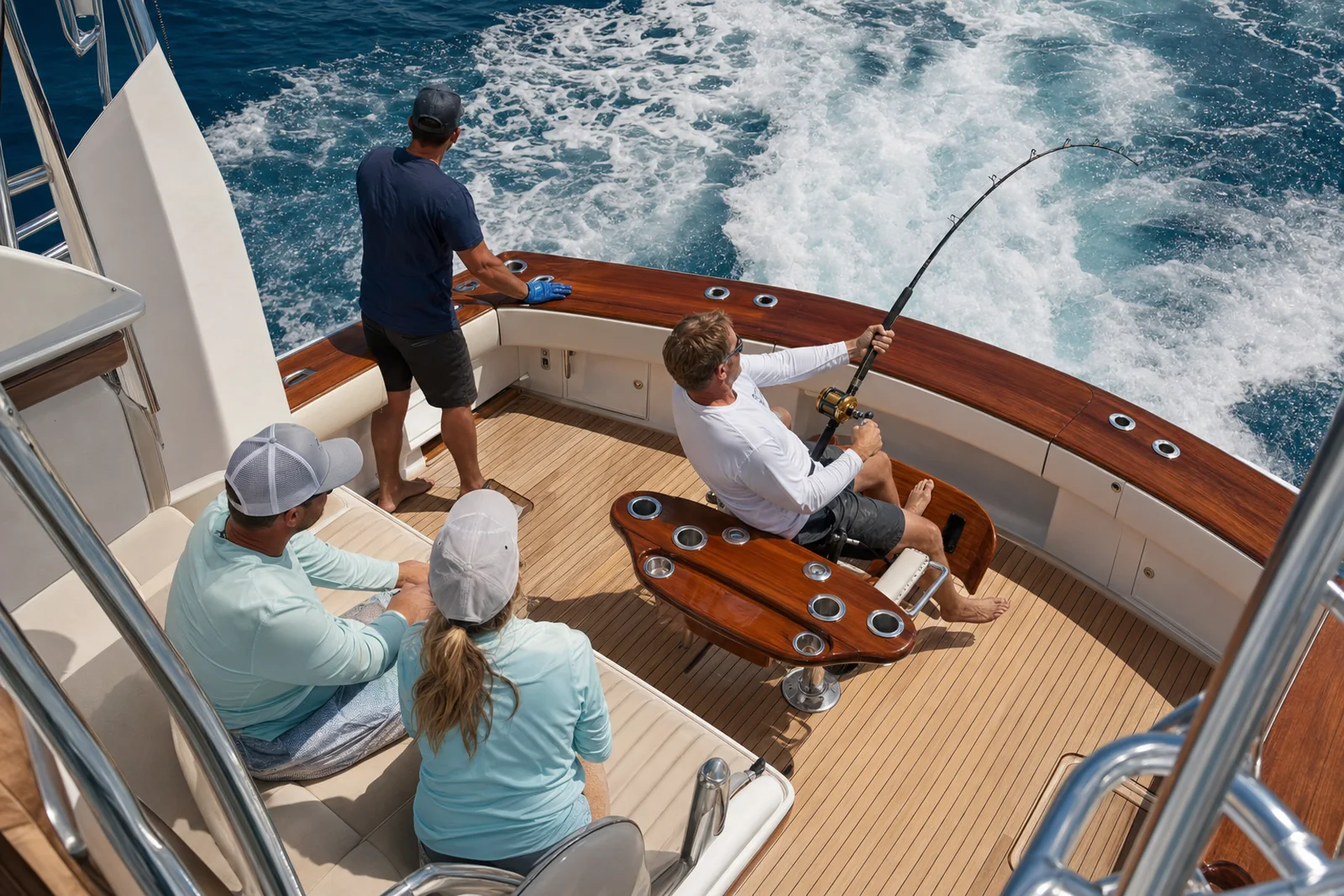
Hooked up in the teak cockpit, seen from the bridge
Plate VII — Cockpit and mezzanine, from the bridge. Artistic rendering.
07

Who this is for

This works if you are:

  • An operator who already runs a successful high-end charter business, or who has run one and wants the right hull to do it on. This is the partner the owner is actually looking for. Bring a book of clients and an operating track record and the conversation is short.
  • A fishing team principal who wants a 76-footer for the season without carrying all of it
  • A licensed captain or charter operator with capital who wants a boat to run rather than a boat to buy
  • Someone who already knows what a boat costs and is not going to be surprised

This does not work if:

  • You want a passive return. The owner is not looking for money — he is looking for an operator.
  • You want something hands-off. There is nothing passive about this.
  • You are expecting the hull to appreciate. It will not.
  • You are unable to fund a capital call on short notice
  • You are uncomfortable sharing a calendar
08

The risks

Anything worth doing has these. Here are the ones that matter.

  1. Utilization is the whole model. Every scenario above turns on charter weeks booked. Eight weeks is roughly breakeven; twelve is comfortable. A soft season is the primary downside risk and it is a real one.
  2. She is thirty-six years old. The refit is extensive and recent, but an older hull carries a higher probability of an unbudgeted mechanical event than a new one. That is what the reserve account is for.
  3. Weather. Hurricane season overlaps the Bahamas shoulder. Insurance, haul-out planning and a named-storm plan are operating requirements, not optional.
  4. Charter is a licensed business. Six-pack limits, USCG requirements, Bahamian permits and charter tax all apply. This is a business with regulators, not a handshake.
  5. Partnerships fail on calendar and capital. Both are addressed in the structure above, and both still require two people acting in good faith.
  6. Illiquidity. A 76-foot sportfisherman is not a quick sale. The buy-sell gives you a defined exit, but plan on a horizon of years, not months.
09

Inquire

Next step

Click here for appointment.

Tell us a little about yourself and you’ll get a call back — usually the same day. The full package includes the complete photo set, the service records, the survey history, and a draft term sheet.

Phone / Text 803‑989‑0031

Vessel lies Fort Pierce, Florida

Showings By appointment

An outright purchase at $595,000 with owner financing available remains on the table for the right party. Say so in the form and it will be treated as a sale inquiry.

Call or text 803‑989‑0031